
Tropical Viral Vaccine Development
In 2022, Nagasaki University was selected as one of the synergy centers to play a central role in vaccine research and development on the “Project for stablishment of a World-Leading Research and Development Center for Vaccine Development,” which was initiated by the Japan Agency for Medical Research and Development (AMED). To implement the research and development plans of the project, the Institute of Tropical Medicine (NEKKEN) of Nagasaki University established the Department of Tropical Viral Vaccine Development (TVVD) in April 2023. The main objective of this (our) department is to further research on the development of medicines for tropical viral infectious diseases, with particular emphasis on the development of dengue vaccines, a priority project of AMED. In this regard, we collaborate with a private pharmaceutical company, the Kyushu-based KM Biologics, to develop a tetravalent live attenuated vaccine for dengue fever. We also have the task of promoting the development of an mRNA vaccine as part of the “100-day vaccine concept,” which is one of the objectives of the AMED project.
Members
- Professor
- Mya Myat Ngwe Tun
- Visiting Researcher: Professor Emeritus
- Kouichi Morita
- Assistant Professor
- Muhareva Raekiansyah
- Research Fellow
- Kenta Fukuda
- Research Fellow
- Nobiko Takayama
- Research Fellow
- Naderi Maliheh
- Research Fellow
- Aung Phyo Wai
- Research Fellow
- Ahmad Ijaz
- Research Fellow
- Yuka Tanaka
- Visiting Researcher
- Shyam Prakash Dumre
- Visiting Researcher
- Thi Thanh Ngan Nguyen
- Assistant
- Taeko Sasaki
- Assistant
- Emi Oba
- Assistant
- Sayuri Yamaguchi
- Assistant
- Atsuko Nakamura
Activities
Our research activities focus on the following key areas:
- Development and Characterization of a Novel Live Dengue Vaccine:
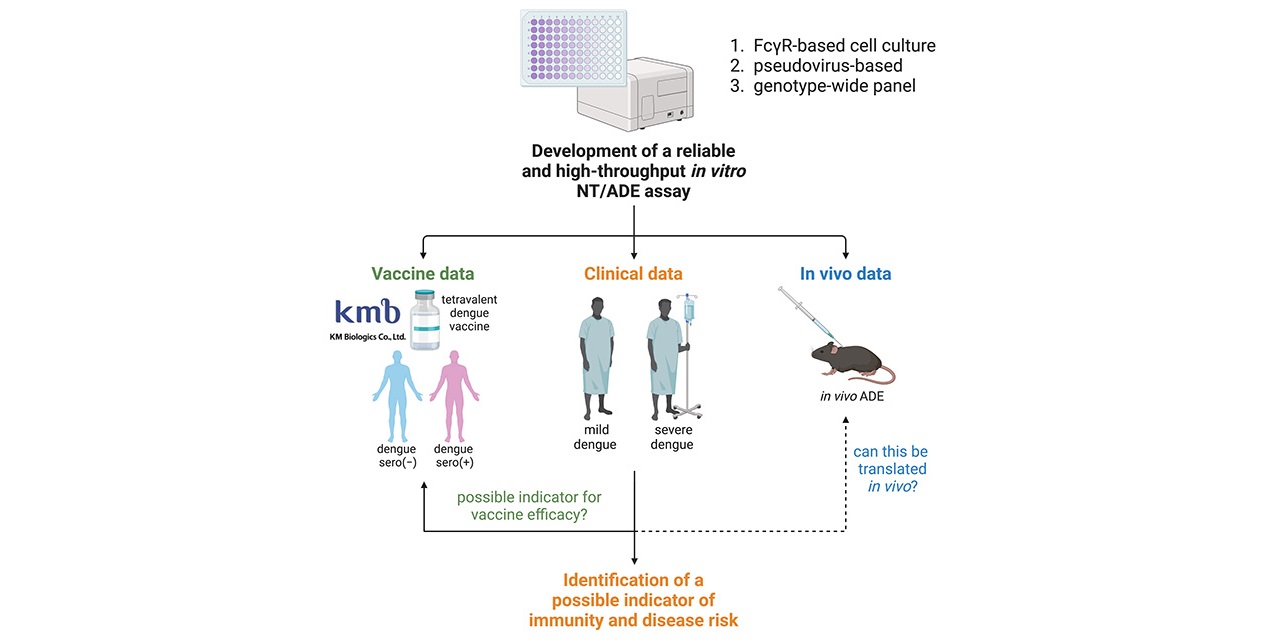
We quantitatively evaluate immune responses, not only in terms of neutralizing antibodies but also antibody-dependent enhancement (ADE), using an assessment and analysis system developed in our laboratory for clinical trials involving live vaccines in humans. - Design and Construction of a Comprehensive Panel of 17 Single-Round Infectious Particles (SRIPs):
These represent all dengue virus (DENV) serotypes and major genotypes. We use this panel for exhaustive neutralization and ADE assays with DENV-specific monoclonal antibodies and clinical samples. These assays are performed using a high-throughput in vitro evaluation system based on immortalized human cell lines. - Development of an Improved ADE Assay:
To enhance detection accuracy, we are developing an improved ADE assay using various FcγR knockout K562 cell lines. Furthermore, we conduct validation experiments in collaboration with the Department of Virology using lentivirus-transduced BHK-21 and Huh-7 cells expressing FcγRIIa and FcγRIIIa. - Structural Basis of ADE Mechanism:
We are collaborating with Department of Virology, NEKKEN, Nagasaki University and Uppsala University to elucidate the structural basis of ADE. - Vaccine Evaluation Using Mouse Models:
We evaluate vaccines against DENV, Severe Fever with Thrombocytopenia Syndrome Virus (SFTSV), and SARS-CoV-2 using mouse models. - Pathogenicity Studies of DENV Using a Novel Mouse Model:
We are developing and analyzing a new mouse model that replicates severe disease caused by ADE to elucidate DENV pathogenicity. - Long-Term Evaluation of Neutralizing Antibodies and ADE in Dengue-Endemic Regions:
We are assessing these immune responses over time in regions with ongoing dengue outbreaks, including the Philippines, Indonesia, Vietnam, and Myanmar. - Serological and Molecular Epidemiological Studies of Arboviruses and SARS-CoV-2 in Asia:
We conduct studies in countries such as Myanmar, Vietnam, Nepal, the Philippines, Sri Lanka, and Malaysia on DENV, Japanese encephalitis virus, Zika virus, chikungunya virus, SFTSV, and SARS-CoV-2. The data from these studies are essential for vaccine development and evaluating the impact of future vaccination programs. - Cross-Reactive Immunity in Flavivirus Infections in Vietnam and Myanmar:
We are studying the role of cross-reactive immunity̶focusing on neutralizing and enhancing antibodies̶in flavivirus infections to inform clinical management and vaccine strategies. - Other Ongoing Collaborative Studies:
- Comparative pathogenicity studies of DENV using mouse models for vaccine development.
- Drug/compound development against SARS-CoV-2 and arboviruses (flaviviruses and SFTSV) by combining two complementary approaches: screening of compounds derived from natural medicinal plants and drug repurposing.
- Investigation on the mechanisms by which these compounds inhibit viral infection or replication.
- Development of point-of-care (POC) diagnostics for SFTSV.
- Detection of cross-reactive peptides derived from SARS-CoV-2 and its variants in serum samples collected in Vietnam before the COVID-19 pandemic, in collaboration with international research institutions.
Recent main research achievement
- Ngwe Tun et al. J Infect Public Health 2025; 18(5): 102709.
- Ngwe Tun et al. J Infect Public Health 2024; 17(6): 1050-1056.
- Ngwe Tun et al. Pathogens 2024; 13(9): 818.
- Balingit et al. Virus Res 2024; 348: 199445.
- Thoresen et al. J Virol 2024; 98(5): e0023924.