
On Wednesday, January 14, 2026, a final project review meeting for Japan was held to report on the tungiasis control project in Homa Bay County, Kenya.
The meeting presented an overview of the project’s activities and achievements over approximately five years since its inception, as well as remaining challenges and considerations for sustainability.
This project focused on strengthening the capacity of Community Health Promoters (CHPs) to ensure the continuous implementation of tungiasis prevention, treatment, and awareness-raising activities at the community level.
As a result, a significant reduction in tungiasis prevalence was observed, with an approximately 97% decrease between 2021 and 2025 in the two targeted sub-counties.
Educational materials such as training manuals, posters, and DVDs were shared with the County and Sub-county Health Offices and are still being utilized in the field.
In addition, through collaboration with diverse partners—including research institutions, private companies, and NGOs—the project developed community-based intervention models, such as low-cost housing floor improvements, that are feasible and sustainable in local settings.
During the meeting, participants also discussed key remaining challenges, including the need for continued support for high-risk households and vulnerable populations, stable supply of treatment and prevention materials, and the establishment of a county-led operational and leadership structure.
It is expected that the knowledge and experience gained through this project will contribute to future tungiasis control efforts and be adapted in other regions.
Following the presentations, an active question-and-answer session was held, during which many practical and insightful questions were raised by participants.
Key discussion topics included:
- Strategies to improve reporting rates at the community level
- Approaches to school-based education that promote behavior change while avoiding stigma or discrimination
- The impact of interventions on high-risk groups such as older adults and children
- Role-sharing and capacity development among community health personnel, including CHPs, Community Health Assistants (CHAs), and Public Health Officers (PHOs)
The discussion highlighted not only the project’s achievements but also encouraged reflection on how tungiasis control activities can be further developed and implemented by different regions and organizations. The meeting thus served as a highly meaningful platform for shared learning and future collaboration.
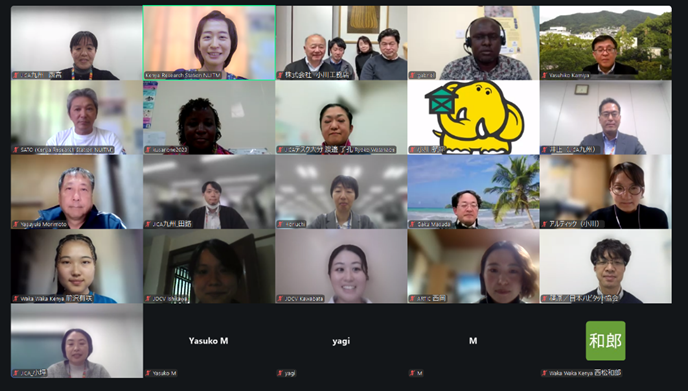
Commemorative photo with participants at the end of the online final project review meeting.