About Us
Mission
The tropics, the most ecologically diverse region on Earth, present an ongoing complexity of tropical diseases and other health problems. In view of the remarkable advances made in international exchange in recent years, it is imperative that these problems be addressed from a global perspective.
Based on this understanding, the Institute of Tropical Medicine, Nagasaki University, aims to overcome tropical diseases, particularly infectious diseases, and various associated health problems. In cooperation with related institutions, the Institute strives for excellence in the following areas:
- Leading research in tropical medicine and international health
- Global contribution through disease control and health promotion in the tropics by applying research findings
- Fostering researchers and specialists in the above fields
Institute of Tropical Medicine, Nagasaki University
1-12-4 Sakamoto Nagasaki 852-8523
TEL +8195-819-7803
Message from the Dean

History
The Institute of Tropical Medicine, Nagasaki University was originally founded in March 1942 as the East Asia Research Institute of Endemics, Nagasaki Medical College in order to perform basic and applied studies on endemic diseases in East Asia. At the beginning, most of its research activities were field studies conducted in mainland China by the Departments of Pathology, Bacteriology, Internal Medicine, and Dermatology of Nagasaki Medical College. August 9th, 1945, the atomic bomb was dropped in Nagasaki, and the Institute's all the facilities and research materials were completely destroyed together with Medical School. Consequently, the development of the Institute and its research activities had lagged significantly behind.
In April, 1946, the Institute changed its name to the Research Institute of Endemics, Nagasaki Medical College, and moved to Isahaya City in May to resume research activities. Yet in accordance with the National School Establishment Law issued in May, 1949, the Institute once again changed its name to the Research Institute of Endemics, Nagasaki University. In 1957, the Institute was affected by another disaster of massive flooding, and its facilities, equipment, and research materials were severely damaged. Thus, construction of a new building started in Sakamoto, Nagasaki City in 1960, and the Institute moved to the building in April of the following year. The Institute's Departments, which were only two at the time, Pathology and Clinics, increased its number every year after 1963, including Epidemiology, Parasitology, and Virology. The Sakamoto building finished its first expansion at the end of 1966.
In June, 1967, with the partial alteration of the National School Establishment Law, the name of the Institute was changed for the third time to the present one to carry out basic and applied studies on tropical medicine. Around the same time, the Department of Internal Medicine, Institute of Tropical Medicine, equipped with 20 beds, was opened in the University Hospital. In 1974, the Department of Bacteriology and the Reference Center were attached, and in 1978, the Department of Preventive Medicine, consisting mainly of visiting professors, associate professors, and researchers, and the Tropical Medicine Training Course were launched. In the ensuing year, the Infectious Animals Depriva-tion Experiment Laboratory was promoted to be-come the Animal research Center for Tropical Infections, and the second building expansion was concluded in March, 1980. In September, 1983, a JICA-sponsored group training program Tropical Medicine Research Course was opened, the Department of Protozoology was established a year after, and the third building extension was finished in July the year after that. Two years later, the Department of Medical Entomology was created and the Institute was reorganized into the collaborative institute in another two years. In 1991, the Department of Biochemistry was added, and the fourth building expansion was ended in March, 1994. In April, 1994, the Institute was divided into three big Divisions, Tropical Microbiology, Pathogenesis and Clinical Sciences, and Environmental Medicine, with the establishment of two new research Departments, Thermal Adaptation and Social Environment, which have expanded to 12 Departments at present. The Institute was desig-nated as Center of Excell-ence in the forefront of scientific research in 1995, and a new research Department, Molecular Epide-miology, was established under the Research Field of Microbiology in 1996 to invite overseas visiting professors. In 1997, the Reference Room for the Tropical Medicine was replaced by the Tropical Disease Information and Reference Center, and it was again succeeded by the Research Center for Tropical Infectious Disease in 2001. In March, 2003, when the Sakamoto build-ing finalized its fifth expansion, its extension work of almost 40 years came to an end. In March, 2006, the main building's repair work was completed. In April, 2008, the Research Center for Tropical Infectious Disease for the Tropical Medicine was replaced by the Center for Infectious Disease Research in Asia and Africa and Tropical Medicine Museum. In June, 2009, the institute was authorized as the Collaborative Research Center on Tropical Disease by the Ministry of Education. More recently, two additional depatments on clinical medicine, i.e., pediatric infectious diseases and clinical pharmaceutical science, were admitted for installation.
In June, 2013, the Animal Research Center for Tropical Infections was closed.
Deans of the Institute
East Asian Research Institute of Endemics
- Susumu Tsunoo
- May. 4, 1942 - Aug. 22, 1945
- Kohei Koyano
- Dec. 22, 1945 - Jan. 23, 1948
- Kiyoshi Takase
- Jan. 24, 1948 - Aug. 31, 1948
- Noboru Tokura
- Sept. 1, 1948 - May. 30, 1949
Research Institute of Endemics
- Noboru Tokura
- May. 31, 1949 - Aug. 31, 1958
- Nanzaburo Omori
- Sept. 1, 1958 - Nov. 30, 1963
- Hideo Fukumi
- Dec. 1, 1963 - May. 31, 1967
Institute of Tropical Medicine
- Hideo Fukumi
- June. 1, 1967 - Nov. 30, 1969
- Daisuke Katamine
- Dec. 1, 1969 - Nov. 30, 1973
- Kaoru Hayashi
- Dec. 1, 1973 - Nov. 30, 1977
- Tatsuro Naito
- Dec. 1, 1977 - Nov. 30, 1979
- Daisuke Katamine
- Dec. 1, 1979 - Apr. 1, 1981
- Keizo Matsumoto
- Apr. 2, 1981 - Apr. 1, 1991
- Hideyo Itakura
- Apr. 2, 1991 - Apr. 1, 1993
- Mitsuo Kosaka
- Apr. 2, 1993 - Apr. 1, 1997
- Akira Igarashi
- Apr. 2, 1997 - May. 31, 2001
- Yoshiki Aoki
- Apr. 1, 2001 - Mar. 31, 2007
- Kenji Hirayama
- Apr. 1, 2007 - Mar. 31, 2011
- Tsutomu Takeuchi
- Apr. 1, 2011 - Mar. 31, 2013
- Kouichi Morita
- Apr. 1, 2013 - Mar. 31, 2017
- Kenji Hirayama
- Apr. 1, 2017 - Mar. 31, 2019
- Kouichi Morita
- Apr. 1, 2019 - Mar. 31, 2022
- Osamu Kaneko
- Apr. 1, 2022 - Mar. 31, 2026
- Satoshi Kaneko
- Apr. 1, 2026 - Up to the present
Organization
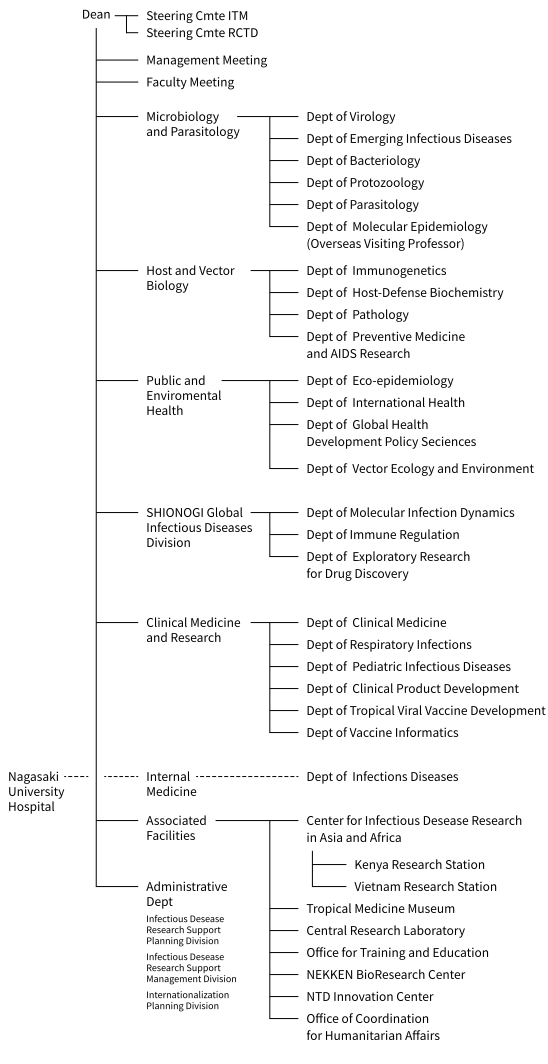
Steering Council Member
- Shigeyuki Kano( National Institute of Global Health and Medicine )
- Yasuhiko Suzuki( Hokkaido University )
- Shinichiro Kawazu( Obihiro University of Agriculture and Veterinary Medicine )
- Kazuya Ikematsu( Nagasaki University )
- Jun Kawakami( Nagasaki University )
- Kiyoshi Kita( Nagasaki University )
- Chiho Watanabe( Nagasaki University )
- Masahiro Nakashima( Nagasaki University )
Directions
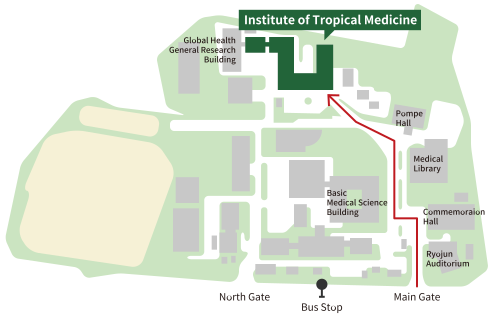
Institute of Tropical Medicine, Nagasaki University
1-12-4 Sakamoto Nagasaki 852-8523
for the campus
From Nagasaki Station (JR Kyushu)
- Streetcar [ for Akasako, Line 1or 3 ]
Get on at Nagasakieki-mae. > Get off at Atomic Bomb Museum. > Ten minutes walk. - Nagasaki Bus [ Line 8 ]
Get on at Nagasakieki-mae. > Get off at Igakubu-mae. > Five minutes walk
From Urakami Station (JR Kyushu)
- Streetcar [ for Akasako, Line 1or 3 ]
Get on at Urakamieki-mae. > Get off at Atomic Bomb Museum. > Ten minutes walk.
From Nagasaki Airport
- Limousinebus [ for Nagasaki, by way of Showa-machi, Sumiyoshi ]
Get off at Nagasakieki-mae, and then continue to "From Nagasaki Station". About one hour by taxi from the airport.
Campus Map